3 Putt Poker
Also known as: Three Putt Poker, Putting Poker
3 Putt Poker is a golf side game that blends putting skill with the luck of a poker hand. Players earn physical playing cards based on how many putts they take on each hole, and at the end of the round, the player who can assemble the best poker hand from their collected cards wins the pot. It’s a fun, social game that keeps everyone engaged on the greens and adds a gambling twist to any round.
At a Glance
- Type
- Individual game
- Players
- 2 or more
- Scoring
- Cards earned based on putts per hole
- Handicaps
- On by default (net putts)
- Wins
- Best poker hand at end of round
The Rules
- Before the round, each player pays an ante into the pot. In return, each player receives 1 starting card dealt from a standard deck of playing cards.
- On each hole, players count the number of putts they take on the green.
- After each hole, players receive (or lose) cards based on their putt count:
- 0 putts (chip-in) — earn 2 cards
- 1 putt — earn 1 card
- 2 putts — no cards earned, no penalty
- 3 putts — no cards earned, plus a money penalty to the pot
- 4+ putts — lose 1 card, plus a money penalty to the pot
- At the end of the round, each player builds the best 5-card poker hand they can from all the cards they’ve collected.
- The player with the best poker hand wins the entire pot.
Card Chart
The default card and penalty settings for each putt count:
| Putts | Cards | Penalty |
|---|---|---|
| 0 (chip-in) | +2 cards | — |
| 1 | +1 card | — |
| 2 | 0 cards | — |
| 3 | 0 cards | Owes to pot |
| 4 | −1 card | Owes to pot |
| 5+ | −1 card | Owes to pot |
Example Round
Four players each pay a $5 ante and receive 1 starting card. Here’s how Player A’s cards accumulate over a few holes:
At the end of 18 holes, all players reveal their cards and build the best poker hand they can. The best hand takes the pot, which includes all the antes plus any three-putt penalties collected during the round.
Dealing Cards In-App
You no longer need to haul a physical deck to the course. Squabbit can now deal the actual playing cards for you, right inside the app, and crown the winning poker hand automatically. Once the round is wrapped up, the host opens the Poker table and deals each player the cards they earned from their putting.
Opening the Poker Table
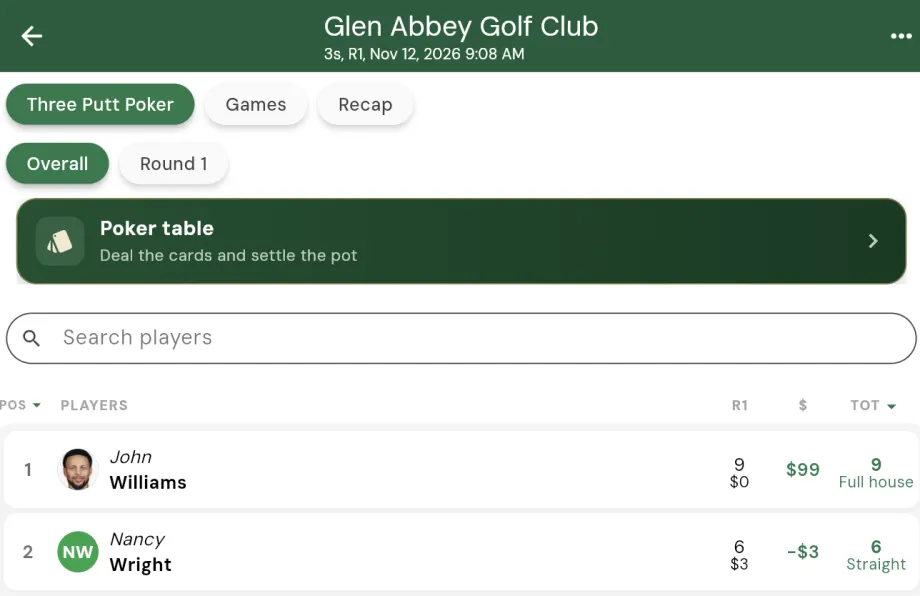
On the 3 Putt Poker leaderboard, look for the felt-green Poker table pill just under the Overall / Round chips, then tap it to open the dealing table. The host sees “Deal the cards and settle the pot,” while everyone else sees “See who drew the winning hand.”
How the Deal Works
Each player draws the exact number of cards they earned from their putts, read straight from the live leaderboard. Cards come from a single shared, shuffled deck dealt without replacement, so no two players ever hold the same card. (For a very large field that needs more than 52 cards, extra decks are shuffled into the shoe, and even then a single player never gets a duplicate within their own hand.)
Round-Robin Dealing
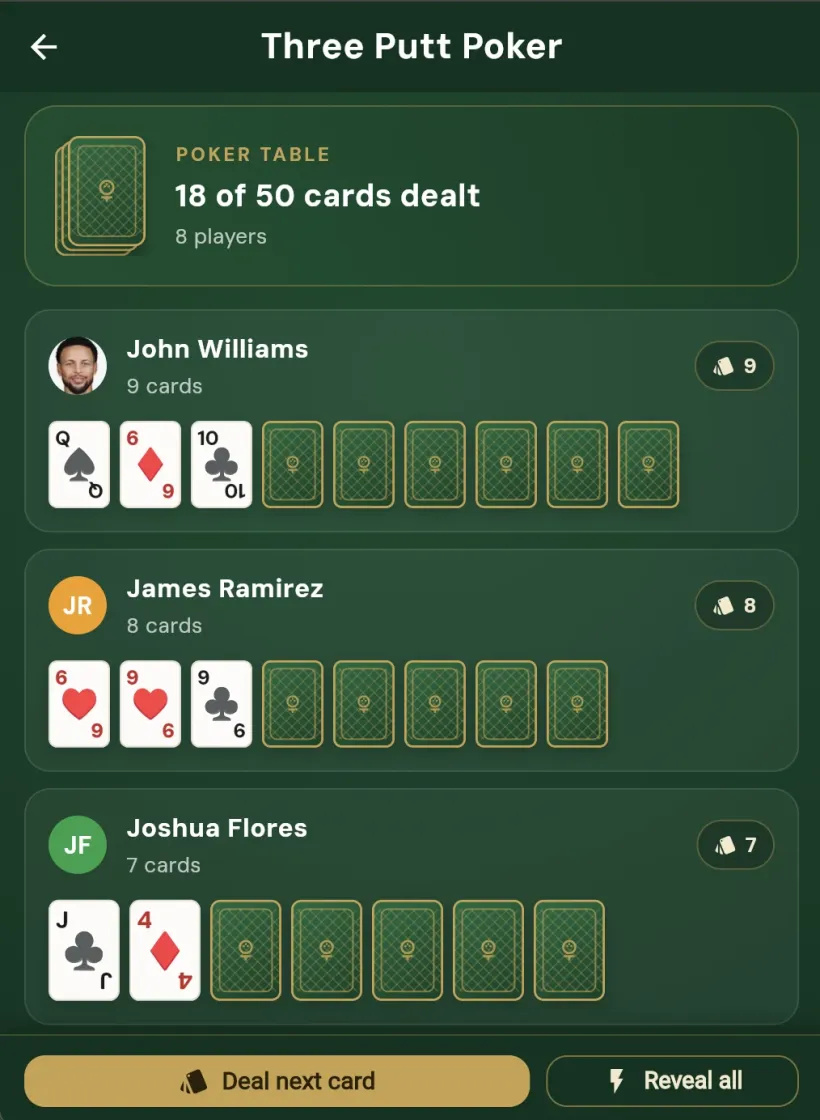
Just like a real dealer, Squabbit deals round-robin: it gives one card to each player per go-around, circling the table before coming back for the next card. Players are ordered with the biggest card stacks first, so the deal builds a little drama as it goes. The table automatically scrolls to whichever seat just received a card, so you always see the action.
Deal Options
The host controls the deal from the action bar at the bottom of the table:
- Deal one by one — deals the hands, then flips cards up one at a time. Tap Deal next card to reveal the next card for the suspense, or Reveal all to flip the rest in a quick cascade.
- Deal all — deals and reveals every card in one go.
- Re-deal — after a deal is complete, re-draws fresh cards and starts the reveal over.
Watching Along & the Winner
The reveal is live: as the host flips cards, anyone following the event on their own phone sees the same cards turn over in real time. When the deal is finished, Squabbit evaluates the best five-card poker hand for each player, crowns the winner with a banner (and a little confetti), and highlights the cards that make up the winning hand. The result feeds straight into the tournament leaderboard, so the event is settled.
Setting Up in Squabbit
To create a 3 Putt Poker game in Squabbit:
- Create a new tournament or casual game.
- Under format, choose 3 Putt Poker.
- Optionally adjust the card chart — change how many cards are earned or lost for each putt count, and set the penalty amounts for three-putts and worse.
- Set the number of starting cards each player receives with their ante (default is 1).
- Add players to the game.
During the round, Squabbit tracks each player’s putt count per hole and automatically calculates the total cards earned and any amounts owed to the pot. The leaderboard shows each player’s card total so you know who’s collecting the most cards heading into the final poker showdown. When the round is done, the host opens the Poker table to deal the actual cards and crown the winning hand — see Dealing Cards In-App for how that works.